Money Habits Start Earlier Than You Think. Try This Weekend.
Here's a fact that surprised us, and might surprise you too: kids start forming money habits between ages 3 and 7.
That's earlier than most of us learned to read.
Research from the Money and Pensions Service (MaPS) confirms that children start to learn vital money skills between the ages of three and seven, and those foundational habits, wants vs. needs, saving vs. spending, patience vs. instant gratification, continue developing through childhood and adolescence.
Which means this: the everyday moments you're already having with your kids, the weekend grocery run, the "can I have that?" at Target, the conversation in the car about why you said no, those aren't just daily logistics. They're your child's earliest financial literacy classroom.
And the best part? You don't need a finance degree to be a great teacher.
Why This Matters More Than Ever
April is Financial Literacy Month, a nationally recognized time to focus on money habits for ourselves and our kids.
Progress is happening in schools. As of March 2026, 39 U.S. states now require passing a personal finance course to graduate high school, up from just 12 states in 2022. But the biggest financial lessons still start at home.
Research from MaPS also found that:
- 88% of kids ages 7 to 17 say they'd go to their parents first for money advice
- Only 24% of kids recall receiving key elements of financial education at home
- Only 56% of parents feel confident talking to their children about money
That gap, between what kids want from us and what we feel equipped to give them, is what this post is here to help close.
3 Simple Activities to Try This Weekend
You don't need apps, workbooks, or a Pinterest-perfect lesson plan. These three activities are powerful, free, and can be done in the next 48 hours.
The 3 Jars Method
This one is a favorite of financial educators for good reason. It's visual, tactile, and works with kids as young as 4.
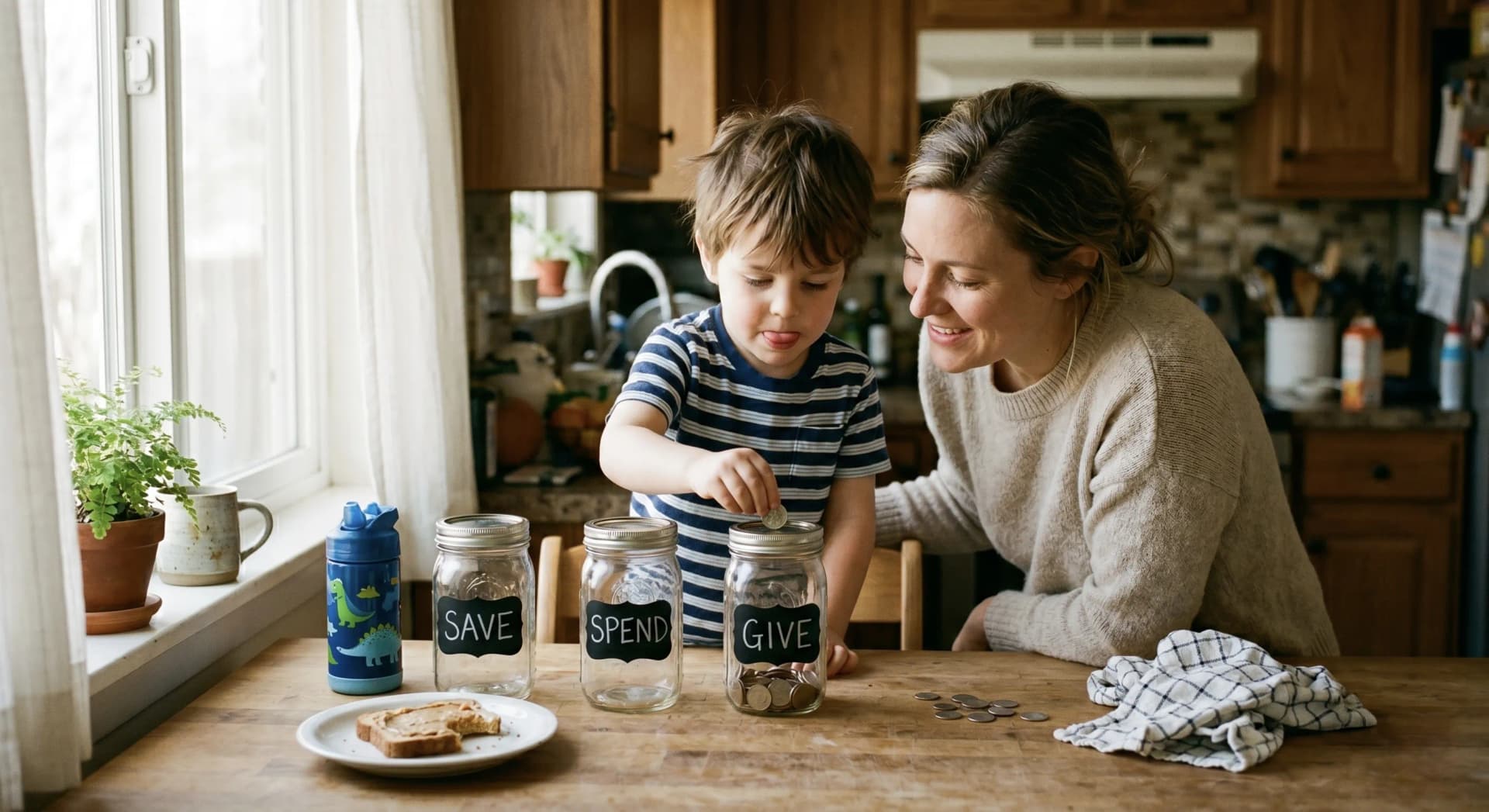
Grab three clear jars (or envelopes, or Tupperware containers, whatever you have). Label them Save, Spend, and Give. When your child receives money, allowance, birthday cash, chore money, they split it between the three jars.
Save is for bigger, longer-term goals like a new toy, a scooter, or a video game. Spend is for everyday wants like a snack or a sticker pack. Give is for others, like donating to a cause or buying a gift for a sibling.
This simple exercise teaches three of the most important adult money concepts, patience, budgeting, and generosity, without a single lecture.
The $10 Budget Challenge
Take your child to the store with exactly $10. Tell them they can buy whatever they want, but only up to $10 total.
Then watch the magic happen. Suddenly they're reading price tags, comparing options, asking "Is this worth it?" and "Can I get two of these instead of one of those?"
This is real-world math, real-world decision-making, and real-world trade-off thinking, all wrapped up in what feels like a fun outing. Try it again a few months later with a slightly bigger budget. You'll be amazed at how their reasoning evolves.
Narrate Your Own Decisions Out Loud
This might be the most powerful one, and it costs nothing.
The next time you're at the store and decide not to buy something, say it out loud. "I'd love to get this, but we're saving for [something] right now, so I'm going to pass." Or when you decide to buy something: "This is more than I'd usually spend, but it's going to last a long time, so I think it's worth it."
Kids absorb how you think about money more than what you tell them about money. When they see you making thoughtful financial decisions and hear your reasoning, you're modeling the exact habits you want them to develop as adults.
Want to Go Further? Open an Investment Account in Their Name.
The 3 Jars method teaches saving. But the real shift, the thing that can genuinely change your child's financial future, is investing.
Here's the difference: a dollar saved in a jar is still a dollar in 10 years. A dollar invested can grow into significantly more thanks to compound growth.
And when you open an investment account in your child's name, they see it grow over time (huge visual impact for kids), you build the habit of contributing regularly, family and friends can contribute for birthdays and milestones, and your child enters adulthood with a real financial foundation, not just lessons.
How UNest Fits In
At UNest, we built our platform for busy parents who want an easy, affordable way to invest in their kids' futures without needing to become financial experts. You can open an account in under 5 minutes, start with as little as you want, automate monthly contributions, and invite family and friends to contribute for birthdays and holidays.
Your weekend lessons plant the seed. An investment account lets that seed actually grow.
The Bigger Picture
Financial Literacy Month will end on April 30. But your child will still be forming money habits on May 1. And June 1. And every day after that, through every ordinary moment they spend watching and listening to you.
That's not pressure. That's a gift. It means every conversation, every trip to the store, every "no" with a thoughtful explanation, is an opportunity.
Start this weekend. Start small. Start with one jar, one challenge, or one out-loud decision.